

Wasden Waterfowl Retreat
SHELLMAN BLUFF RD NE, Townsend, GA | Lat/Lng: 31.5661, -81.4122
$875,000
67.71 ac.
12/06/2024
ACTIVE
Description
McIntosh County, Georgia · 67.61± Acres · $875,000
Bullet Points:
67.61 +/- Acre Waterfowl Recreational Property, McIntosh County, Georgia
Property Type - Recreational - Turnkey Duck, Deer and Turkey Hunting - Surrounded By 100K Acres of Conservation Land that are Home to 17 Different Duck Species - 16 Different Species Harvested on Wasden Pond
Access - Gated; single entry point off Shellman Bluff Road via an easement road flanked by freshwater swamp, protected by a culvert system that keeps it passable when the swamp is flooded
Location - 20 minutes to Darien; under 10 minutes to I-95; 5 minutes to a public boat landing; 5 miles to Atlantic Ocean and Intracoastal Waterway access
Waterfowl Infrastructure & Improvements
Duck Pond - 2-acre planted, irrigated, floodable duck pond — planted in corn. (3) additional planted 1-acre duck holes each with 2-man buried pit blinds that have platforms for your retrievers.
4 separate pond locations to hunt.
Water Control - Flashboard riser system harnessing natural watersheds; culvert system under interior roads for drainage and water-level control
Wells - Two wells — one feeds the flooding of the duck pond, the other serves the cleared homesite; buried irrigation waters the planted corn before flooding
Surface Water - Approximately 43 of the 67.61 acres carry surface water — abundant freshwater swamp habitat
Duck Blind - Arkansas-style duck blind for 18 — 16 shooters plus 2 guides — with underground electricity; refrigerator, freezer, Blackstone grill, Camp Chef oven, and space heaters for cold coastal-Georgia mornings; refrigerator finished in army green. Three sets of stairs leading to water give easy access for dogs to retrieve ducks. A covered platform underneath the blind is perfectly suited to park your duck boat and walk up back steps into blind area.
Pit Blinds - Three two-man buried pit blinds, each set in its own separate 1-acre planted duck hole — camouflaged and painted with dog platforms for your retrievers which are oriented to face both north and south to work the wind from one position
Other Hunting Setup - Three 1,000-lb corn feeders; One 600-lb corn feeder, three box blinds; 2 tower blinds; four ladder blinds; multiple painted duck boxes; winter rye planted along all road systems. Interior road systems are a combo of packed bedrock with culvert systems to control drainage making them passable all year round.
Power - Electric power brought to the property, including underground service to the duck blind; power in place at the cleared homesite
Homesite - Cleared homesite on high elevation, with power already run and its own well — ready for a new owner to build a weekend hunt cabin
Habitat, Wildlife & Investment
On-Property Waterfowl - Wood ducks, teal, ring-necked ducks, some black duck, hooded merganser, and black-bellied whistling duck harvested on Wasden Pond
First Season Harvest - Approximately 40 dozen birds in the first full hunting season, with a strong December migration influx and 16 different species harvested.
Other Game - Strong deer and turkey populations; a Boone and Crockett-class whitetail was taken two years ago on the directly adjoining 1857 acre timber property
Habitat - A diverse coastal mix of oak hammocks, planted pine, and wetland areas — excellent year-round habitat for ducks, deer, and turkey. Note: there is a great place to add a dove field if the next landowner desired
Timber - 2022 timber cruise estimated approximately $140,000 in merchantable timber
Conservation Setting - Surrounded by 100,000+ acres of conservation land and protected open space on the Atlantic Flyway, in Georgia's “Conservation Coast”
Prior Use - Used for private recreational hunting only, ensuring pristine condition and low-impact use
Conservation Land in McIntosh County, Georgia - Home to 17 Different Duck Species (See Website Details for List)
Sapelo Island 16,500 Acres – Fourth largest barrier island on the coast of Georgia
Altamaha Waterfowl Area - 11,278 Acres – Located in the Altamaha River Delta and encompasses many historical rice fields great for waterfowl
Blackbeard Island National Wildlife Refuge - 5618 Acres – Owned by FWS – Fish and Wildlife Service
Townsend Wildlife Management Area - 8,114 Acres – Includes woodlands, fresh water swamps and ridges
Wolf Island National Wildlife Refuge - 4000 Acres – Known as the shorebird reserve for the Georgia Coast
Townsend Bombing Range - No Public Access - 33,000 Acres – woodlands, freshwater swamps, and a few open field environments
Eulonia Tract of the Richmond Hill Wildlife Management Area - 2,015 Acres – primarily upland and freshwater swamp
Harris Neck Wildlife Refuge - 2,824 Acres – refuge and rookery for wood storks
Altamaha Wildlife Management Area - 30,000 Acres – One of the largest WMA’s in the county
A turnkey coastal-Georgia waterfowl property on the Atlantic Flyway
Wasden Waterfowl Retreat's 2-acre duck pond is planted, irrigated, and fully floodable, anchored by an 18-person Arkansas-style blind — and it produced 40 dozen birds in its first season with 16 different species harvested. A built pond. A proven season. A finished property that's turnkey, and ready to hunt.
Wrapped in 100,000+ acres of conservation land. Sixty-eight acres on the Atlantic Flyway, buffered by protected land on every side — beside the delta Georgia DNR calls the state's premier waterfowl area. You can't manufacture a location like this.
Duck, deer, and turkey — one property. Oak hammocks, planted pine, and wetlands each pull their own game, with a Boone and Crockett-class buck harvested on the adjoining 1857-acre timber tract and $140K in merchantable timber underwriting it all.
The Place
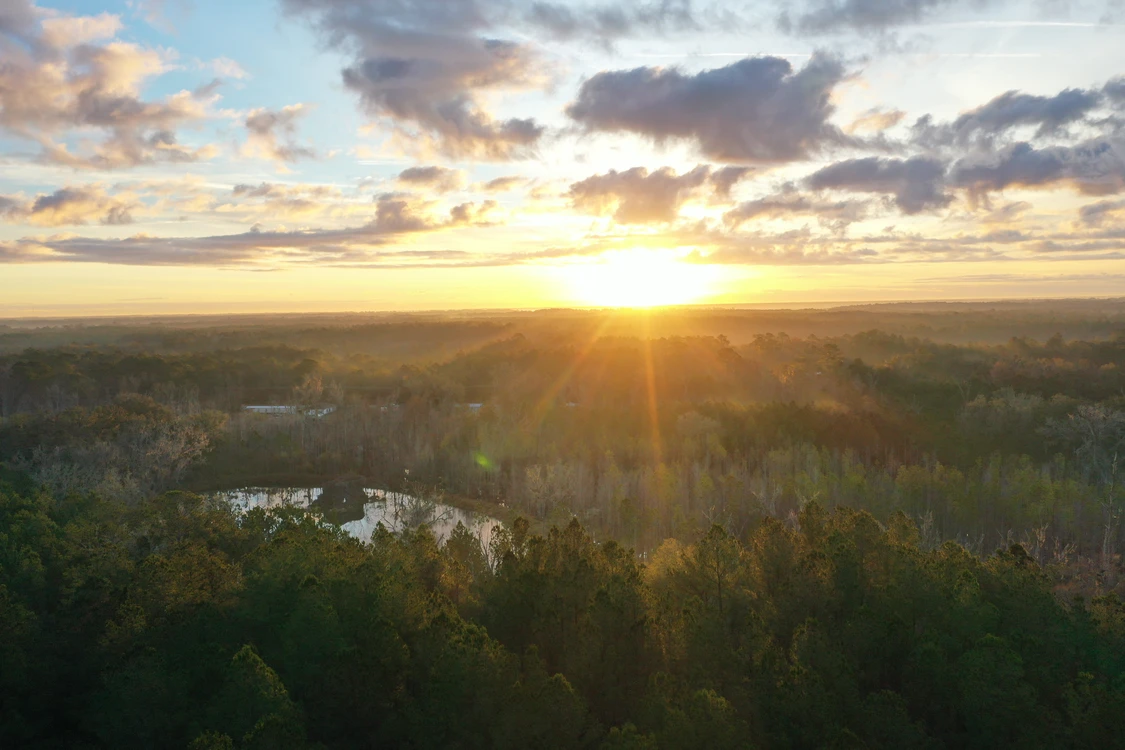
There is a stretch of the Georgia coast where the land is plentiful with oak hammocks, planted pine, freshwater swamp, and hardwood bottom that fold into the great tidal sweep of the Altamaha River Delta. This is the Conservation Coast, and it is one of the richest waterfowl landscapes in the Southeast. Wasden Waterfowl Retreat sits inside it: sixty-seven and a half acres in McIntosh County, gated and quiet, surrounded on every side by more than one hundred thousand acres (100K) of conservation land and protected open space providing a home to over 17 different duck species.
It is a small property by the measure of acres, and an unusually complete one by every measure that matters to a waterfowler. At its heart is a two-acre planted, irrigated, flood-able duck pond — built, not found — fed by new wells and buried irrigation, controlled by a flashboard riser system that harnesses the land's own watersheds. Power has been brought in. There are three additional 1-acre planted duck holes with buried 2-man pit blinds in each hole providing 4 different options for hunt locations. A homesite has been cleared on high ground. And the hunt itself has been set quietly into the landscape, down to duck blinds painted and buried so they do not break the line of the marsh.
The property takes its name from George Wasden — the conservationist and lifelong outdoorsman who built it. It is named, plainly and rightly, for the man who shaped it, and a property like this does not come together by accident. It comes from a particular kind of person, working a particular piece of ground with a lifetime of knowledge in his hands. To understand Wasden Waterfowl Retreat, you have to begin with him.
A Word About the Land Steward
Every property carries the imprint of the hands that kept it. Wasden Waterfowl Retreat carries the imprint of George Wasden — and that is the first thing a buyer should understand about this place.
George is a conservationist by heart, a man with a logger's working knowledge of land and a deep passion for the outdoors. He has taken this ground on the coast of Georgia and, drawing on a lifetime of understanding how land works, shaped it into something rare here: a premier Arkansas-style duck hunt experience, built where the Altamaha Delta already makes the coast of Georgia one of the great waterfowl landscapes in the Southeast.
Wasden Pond is not George Wasden's first rodeo.
Wasden Waterfowl Retreat is the fourth property George has stewarded — and, as with the three before it, he leaves it better than he found it. Before this, George's career rehabbing and improving waterfowl land moved from tract to tract across Georgia. It began near Herndon, with a 300-acre duck tract where he created ten duck holes before selling it on to fellow waterfowler Skip Newman. Then came the 800-acre, 16-impoundment duck property on the Geechee River — a property of such quality that it was purchased by the owner of RecTeq, the grill company out of Augusta, Georgia. After that came the 2,100-acre tract near Millen, in Jenkins County; George rehabbed that land, and it was ultimately placed under a permanent Wetland Reserve Easement (WRE) with the State of Georgia — the kind of protection the State actively seeks, and the kind of legacy a true steward leaves behind. It is the truest measure of a steward's work: land cared for so well that its protection becomes its future.
For George, this retreat has been a labor of love — wells drilled, power brought in, irrigation buried to feed the duck pond, a homesite cleared, easily navigable bedrock road systems with culvert systems, duck boxes and duck blinds set quietly into the landscape. Not improvements made to a property to sell it, but improvements made to a property because that is simply how George Wasden keeps land. His passion runs to one thing in particular: building duck habitat on the Georgia coast, taking ordinary low ground and teaching it to hold water, grow feed, and draw birds the way the great delta marshes do.
The next owner of Wasden Waterfowl Retreat inherits more than acreage and infrastructure. They inherit a place already loved, already shaped with care, already pointed toward its best life — and the quiet responsibility of carrying that forward. Because here, a
Details
County: McIntosh
Zipcode: 31331
Property Type One: Recreational Property
Property Type Two: Timberland
Property Type Three: Hunting Land
Brokerage: Jon Kohler & Associates
Brokerage Link: www.jonkohler.com
Lori Weldon
Jon Kohler & Associates
(229) 977-6065
By clicking the button, you agree to our Terms of Use and Privacy Policy.


Nearby Listings
Liberty County, GA

$1,900,000 - 3 ac.
Liberty County, GA

$285,000 - 5 ac.
Glynn County, GA
$2,466,428 - 315 ac.
Wayne County, GA
$299,000 - 66 ac.
Liberty County, GA
$2,999,000 - 344 ac.
Glynn County, GA

$419,000 - 1 ac.
Brantley County, GA
$245,900 - 3 ac.
McIntosh County, GA
$1,920,000 - 320 ac.
McIntosh County, GA

$125,000 - 1 ac.
McIntosh County, GA
$899,500 - 1 ac.